Why Do Waterfalls Never Run Out of Water?
Updated July 2026 · 6 min read · WaterfallFinder Editorial
Quick answer
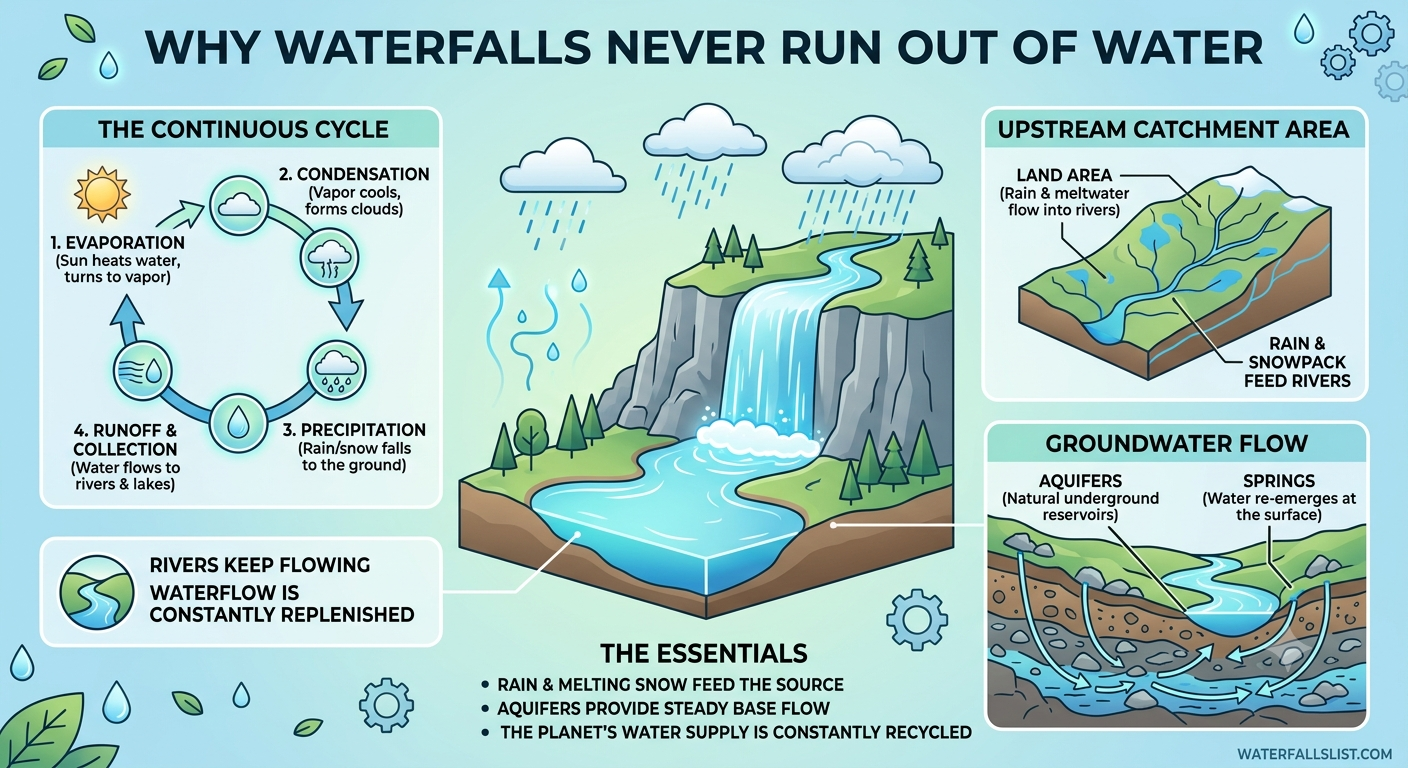
Waterfalls almost never run out of water because the rivers that feed them are constantly refilled by the water cycle. Rain and melting snow across the upstream catchment area flow into the river, and groundwater stored in underground aquifers keeps releasing water through springs — even during dry spells. As long as some rain or snow keeps falling somewhere in the catchment, the waterfall keeps flowing.
How Do Waterfalls Keep Flowing?
A waterfall is simply the point where a river drops off a cliff, so its water supply is the same as the river's. That river is fed by three overlapping systems that all trace back to one thing: the water cycle.
1. Precipitation — rain and snow refill the source
Every day the sun evaporates water from oceans, lakes and even soil. That vapour rises, condenses into clouds and eventually falls back to the ground as rain or snow. This never-ending loop is called the hydrologic cycle by the USGS, and the total volume of water on Earth stays almost exactly the same year after year — only its location changes.
2. The upstream catchment area
Every waterfall sits at the bottom of a large upstream catchment (also called a "drainage basin" or "watershed"). Rain and meltwater from anywhere across that catchment — sometimes thousands of square kilometres — flow downhill into small streams, then bigger streams, then the main river that plunges over the fall. Because rain rarely stops everywhere in a big catchment at once, most waterfalls keep flowing year-round.
3. Groundwater and springs — the hidden base flow
Even in dry weeks the water doesn't stop, thanks to aquifers: natural underground reservoirs that store rainwater that soaked into the ground months or even years earlier. Aquifers slowly release that water back to the surface through springs that feed rivers with a steady "base flow." This is why famous falls like Havasu Falls in Arizona keep running even in the middle of the desert.
Do Waterfalls Ever Actually Dry Up?
Yes — some do, mostly seasonally or temporarily. Waterfalls that dry up usually fall into one of these categories:
- Seasonal waterfalls in dry climates: Yosemite Falls often reduces to a trickle or stops flowing altogether in late summer, typically August to October, once the Sierra snowpack has melted out.
- Drought-affected falls: multi-year droughts can starve a catchment of rainfall. During the 2018-2019 Australian drought, tourists were shocked when smaller falls in the Blue Mountains ran completely dry for months.
- Diverted or dammed rivers: some falls have had their water re-routed for hydropower or irrigation. This is by far the most common cause of a "big" waterfall going quiet (see the next section).
- Frozen falls: strictly speaking they haven't dried up, but sub-zero temperatures at falls like Niagara can create spectacular ice formations that briefly slow the visible flow to a crawl.
Famous Waterfalls That Stopped Flowing
Niagara Falls — turned off in 1969
In June 1969, the U.S. Army Corps of Engineers actually turned off the American side of Niagara Falls for several months by building a temporary rock dam upstream. They wanted to inspect erosion at the base. Photos of a dry Niagara look like another planet. See the Smithsonian's write-up for the full story.
Victoria Falls — a seasonal trickle
Victoria Falls on the Zambezi River is one of the world's largest waterfalls in wet season, but it reduces to a fraction of its flow in October and November each year. Prolonged droughts in 2019 caused the Zambian side to nearly stop entirely — an alarming reminder that even iconic falls depend on rainfall hundreds of kilometres upstream.
Guaíra Falls — permanently drowned in 1982
The mighty Guaíra Falls on the Paraná River (Brazil–Paraguay border) was once one of the largest waterfalls on Earth by volume. It was deliberately submerged in 1982 when the Itaipu Dam reservoir filled. The falls didn't dry up — they were drowned — but the result is the same: no more waterfall.
Rjukanfossen — turned off for a century
Norway's Rjukanfossen was diverted into hydropower tunnels in 1911 and effectively vanished. Only in 2014 did the local municipality begin releasing water back to the historic falls on selected summer Sundays as a tourist attraction — an example of how quickly a waterfall can be switched on and off by human engineering.
What Would It Take to Make a Waterfall Run Out?
For a natural waterfall to permanently dry up, something has to break the water cycle upstream. That could be:
- A permanent shift in climate that eliminates precipitation across the entire catchment (a very slow, very rare change on human timescales).
- Complete depletion of the upstream aquifer — usually only possible through heavy irrigation pumping.
- Engineering — a dam, canal, or hydro-diversion. This is by far the most common real-world cause.
For the vast majority of waterfalls in the world, all three of those would have to happen at once. That's why waterfalls are still one of the most reliably beautiful things in nature — and why, on any given day, you can find one near you that's flowing.
Key Takeaways
- Waterfalls don't create water — they just drop the water their upstream river is already carrying.
- Three systems refill that river continuously: rain, snowmelt, and groundwater base flow from aquifers.
- Some falls do dry up — seasonally in dry climates, during severe droughts, or when their rivers are dammed.
- The best time to visit is usually within a month of the wet season or peak snowmelt for your region — check the "Best time to visit" section on each waterfall page.
References
- U.S. Geological Survey — The Water Cycle
- U.S. Geological Survey — Springs and the water you drink
- Smithsonian Magazine — Half a century ago, someone turned off Niagara Falls
- Zambezi River Authority — historic Victoria Falls flow records.