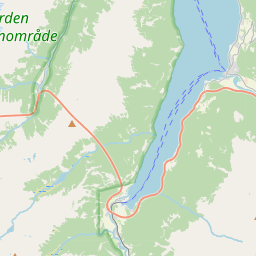
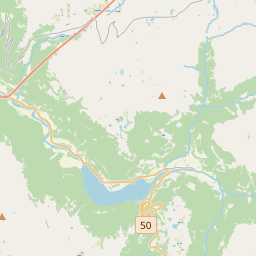
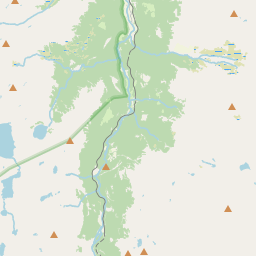
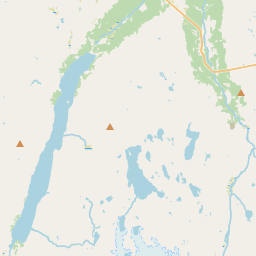
Most waterfalls in Norway ask something of you. A hike, a ferry, a long drive down a fjord road with your knuckles white on the wheel. Kjosfossen doesn't ask for any of that. You buy a train ticket, you sit down, and about forty minutes later the carriage brakes, the doors open, and there it is — 225 metres of water crashing down a mountainside right next to the platform. That's the trick of Kjosfossen. It's one of Norway's most visited natural attractions, and almost nobody who sees it had to work for the view. Where It Sits, and Why the Train Matters Kjosfossen is tucked into the Flåm Valley in Aurland Municipality, on the western side of Norway, about four kilometres before the train reaches Myrdal station. The Flåm Railway, or Flåmsbana, runs between Myrdal and Flåm, dropping close to 900 metres over twenty kilometres of some of the steepest standard-gauge track in the world. Kjosfossen is the one stop built purely so passengers can get off and look. It's been there since 1951, and the platform still exists for no other reason. You genuinely can't get to Kjosfossen by road. There's no car park, no trailhead, no shortcut. If you want to stand in front of it, you're on that train. What Happens When the Train Stops The train pulls up almost level with the lower section of the falls, and the doors open onto a short wooden platform. Even before you step outside you can hear it — a low roar that gets louder the closer you get to the rail. The spray reaches the platform too, especially when the flow is high in summer, so don't be surprised if you walk back to your seat a little damp. Kjosfossen actually falls in two stages, which gives it an hourglass shape rather than one clean drop. The upper section is the part most visitors see clearly from the platform; the water then narrows and continues down through a gorge that isn't fully visible from where you're standing. There's also a small hydroelectric power station built into the falls, which supplies electricity to the railway itself — a detail that's easy to miss with all that water in front of you, but it's part of why the stop exists at all. You get roughly five minutes here. It sounds short, and it is, but it's enough. The Woman in Red In the warmer months, the stop comes with something extra. As the train slows down, a figure in a flowing red dress appears on the rocks near the waterfall and begins to dance, moving with the mist and the sound of falling water. She's playing the Huldra — a figure from Norwegian folklore, a forest spirit said to lure travellers deep into the woods with her beauty, only for her true, hollow back to be revealed once it's too late. The performers are students from the Norwegian Ballet School, and the whole thing runs only during the summer season, when the stop itself is open. Whether you catch her depends a bit on timing and season rather than luck alone, but when the red dress appears against all that grey rock and white spray, it's easy to see why the legend has stuck around this particular stretch of mountain for so long. Getting There There's only one way in, and it's the Flåm Railway. You can join it from either end — Myrdal, which connects to the Bergen Line, or Flåm village, down on the Aurlandsfjord. Either direction takes around an hour, and Kjosfossen is roughly two-thirds of the way along, closer to the Myrdal side. Buy your ticket ahead of time in the busier months, particularly summer, when the train and the platform can both fill up fast. If you're coming from Bergen or Oslo, the Bergen Railway connects through Myrdal, so you don't need a separate trip to reach the start of the line. A Few Things Worth Knowing Before You Go The stop only runs during the operating season, so if you're travelling in deep winter, don't count on the platform being open or the Huldra performing — check current timetables before you plan around it. Bring something waterproof for your camera or phone if you want photos; the spray is heavier than it looks from inside the train. And once you're on the platform, move toward the far side rather than crowding the exit — the view opens up more once you're clear of the doors, and the train genuinely won't leave without you. Why It's Worth the Stop Kjosfossen isn't the tallest waterfall in Norway, and it isn't the hardest to reach — it's the opposite, really. What makes it worth talking about is how much it packs into five minutes: the sound, the cold mist on a summer afternoon, the mountains rising on either side of the valley, and then, if you're lucky, a dancer in red appearing out of the spray like something the valley invented just for you. You get back on the train a little wet, a little louder in your own head, and the doors close behind you as the falls disappear around the next bend.
Kjosfossen


Waterfall height
Plan your visit to Kjosfossen
Please verify on the official website before you go
Why is Kjosfossen famous?
Kjosfossen is famous as one of Norway's most-visited waterfalls due to its dramatic 225-meter drop and location along the iconic Flåm Railway, where the train stops for viewing. During summer, traditional dancers (huldra figures from Norwegian folklore) perform on the rocks beside the falls, creating a unique cultural-natural spectacle.
Can you swim at Kjosfossen?
No — Kjosfossen is a powerful 225m waterfall viewed from the Flåm Railway platform; swimming is not possible. Please verify on the official website before you go.
Are dogs allowed at Kjosfossen?
Dogs allowed on-leash on the Flåm Railway and at the viewing platform. Please verify on the official website before you go.
Is Kjosfossen free? Do you need a permit?
Free to visit if hiking, but most visitors access via Flåm Railway which requires a paid train ticket (approximately 590-790 NOK). Please verify on the official website before you go.
Is there parking at Kjosfossen?
Parking is at Flåm Railway Station in Flåm village (paid parking available). Kjosfossen is accessed via the Flåm Railway train, not by car. Please verify on the official website before you go.
How long is the hike to Kjosfossen?
No hike required — Kjosfossen is viewed from a dedicated platform where the Flåm Railway stops for approximately 5 minutes. Please verify on the official website before you go.
Kjosfossen hike difficulty
Roadside (no hike) — the train stops at a viewing platform with steps down to the waterfall viewpoint; minimal walking required. Please verify on the official website before you go.
When is the best time to visit Kjosfossen?
May to September for best weather and full railway operation, with peak waterfall flow in late spring/early summer from snowmelt. Please verify on the official website before you go.
Kjosfossen official website
Attractions near Kjosfossen
- •Flåm Railway (Flåmsbana) — one of the world's steepest standard-gauge railways with stunning scenery
- •Aurlandsfjord — scenic fjord branch of Sognefjord, perfect for boat tours and kayaking
- •Stegastein Viewpoint — dramatic architectural viewpoint 650m above Aurlandsfjord, 20 min drive
- •Myrdal Station — mountain railway station at 867m elevation, hiking trails to surrounding peaks
- •Flåm village — charming fjord village with museums, restaurants, and fjord cruise departures
Safety information
Waterfalls can be unforgiving. Read these before you go — and please, use your judgement on the day.
Full safety guide →Questions & answers
No questions yet — be the first to ask.
More to explore nearby
Vøringsfossen
Eidfjord, Vestland
Norway's most-visited waterfall plunging into Mabodalen valley.
Langfoss
Akrafjord, Vestland
One of the world's most beautiful waterfalls per CNN.
Vettisfossen
Årdal, Vestland
Norway's tallest unregulated free-falling waterfall.
Låtefossen
Odda, Vestland
Twin Hardanger cascade thundering under a stone bridge.